
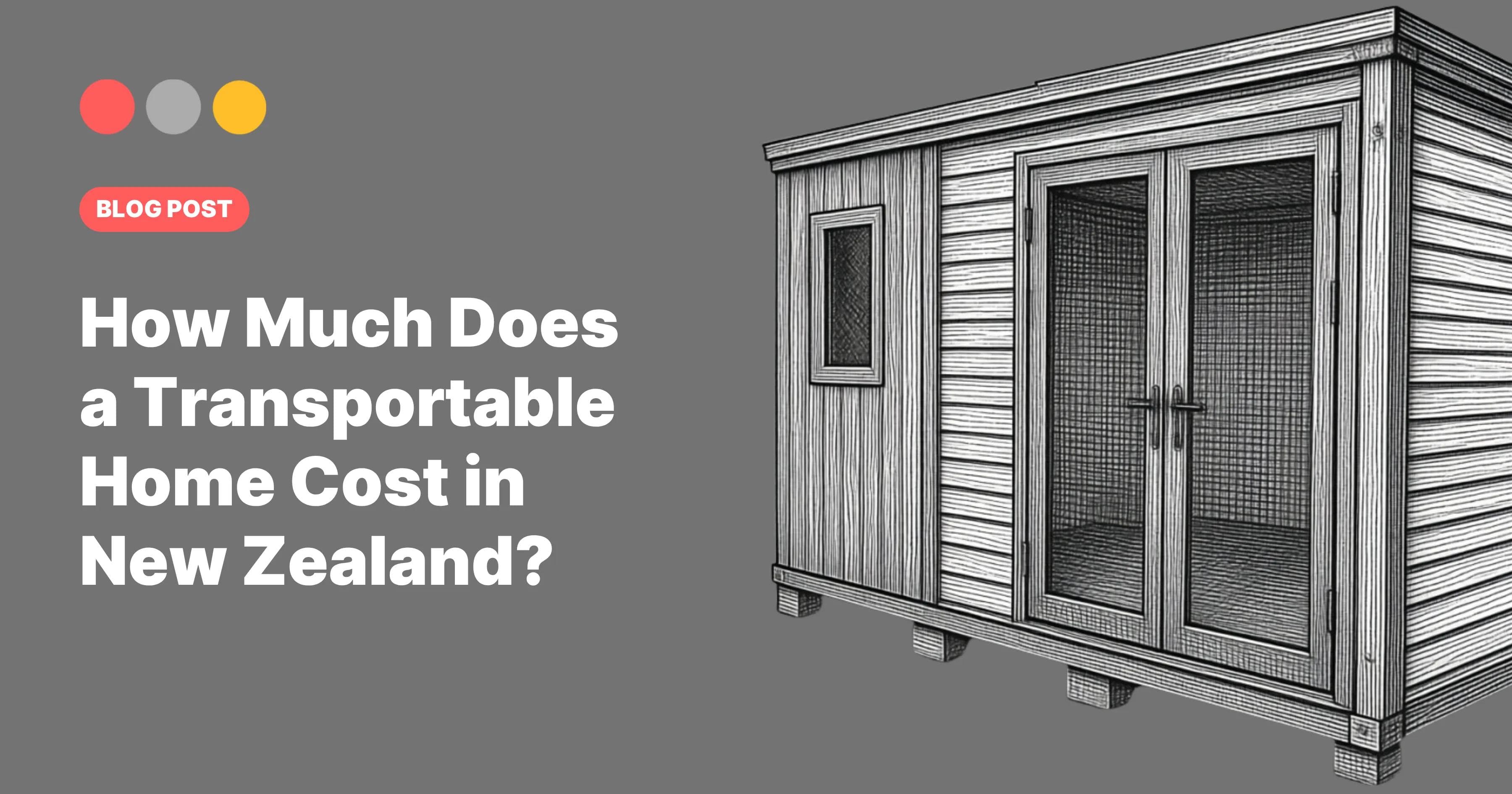
One of the first questions buyers ask is simple: how much does a transportable home actually cost? The honest answer is that it varies, and often by more than people expect.
That is because the advertised price for a transportable home is usually only one part of the total project cost. The home itself matters, of course, but so do delivery, crane access, foundations, services, site preparation, and the level of finish you want. If you are comparing options in New Zealand, the smartest approach is to think in terms of the full installed cost rather than just the base price of the building.
What affects the cost of a transportable home?
The biggest cost factor is the home itself. Size, layout, materials, insulation, glazing, kitchen and bathroom specification, and whether the design is standard or customised all influence the starting price. A compact, straightforward unit will usually cost much less than a larger self-contained home with premium finishes.
The next major factor is transport. A home being delivered a short distance on simple roads is one thing. A home travelling a long way, crossing more difficult routes, or requiring specialist logistics is another. Narrow accessways, steep sections, power lines, bridge limits, and the need for cranes can all add cost.
Foundations and site works also matter. Even when the home is built off-site, you still need the section prepared so it can be installed properly. That may include levelling, access improvements, drainage, retaining, piles or foundations, and any work needed to make the site build-ready.
Then there are services. Connecting power, water, wastewater, stormwater, internet, and any heating or ventilation systems can add meaningfully to the total. Some sites are straightforward. Others are more complex and more expensive.
Finally, there are optional extras. Decking, verandas, upgraded cladding, higher-end appliances, better joinery, solar-ready features, and custom finishes all change the final figure. None of these are necessarily bad choices, but they need to be budgeted for clearly.
Why buyers often underestimate the total cost
The most common mistake is to compare the price of a transportable home with the full cost of a traditional build without comparing like for like. A base transportable-home price is not usually the same thing as a complete move-in-ready cost.
That does not mean transportable homes are poor value. In many cases, they are still a very attractive option because they can reduce build time, improve cost certainty, and simplify the overall process. It just means buyers need to be realistic about what sits outside the base price.
At Portable Building Specialists, this is where a lot of early planning helps. Once buyers start factoring in site access, foundations, services, and layout choices, it becomes much easier to see which option genuinely fits their budget.
Typical pricing approach
Rather than relying on one universal number, it is more useful to think about transportable-home pricing in layers.
- First, there is the building cost. This is driven mainly by size and specification.
- Second, there is delivery and installation. This depends heavily on distance and site conditions.
- Third, there is site preparation and foundation work.
- Fourth, there are utility connections and finishing items.
By the time all four layers are added together, the difference between two homes that looked similar on paper can become quite significant.
As a general rule, smaller and more standardised homes sit at the lower end of the range, while larger self-contained homes, granny flats, and higher-spec designs sit at the upper end. Customisation nearly always pushes cost higher, but it can also improve usability if the home is being designed for long-term living.
Transportable home cost vs traditional build cost
Transportable homes are often compared with a traditional site-built house because the buyer is ultimately trying to answer the same question: what is the most practical way to create a quality home on this section?
In many cases, a transportable home has three major advantages:
- Faster delivery. Much of the build happens in a controlled environment, so there is less exposure to weather delays and fewer moving parts on site.
- Better cost certainty. Standardised models and factory processes can make pricing more predictable than a fully custom on-site build.
- Less complexity. A shorter on-site programme can reduce disruption and narrow the window for unexpected delays.
That said, transportable homes are not automatically the cheapest option in every scenario. Difficult sites, complex delivery requirements, premium upgrades, and extensive service work can close the gap. The right comparison is the total project cost, not just the advertised base price.
Questions to ask before you compare prices
If you are getting quotes, ask these questions early:
- What exactly is included in the base price?
- Does the quote include delivery?
- Are foundations included or separate?
- What site works are assumed, and what happens if the site is more complex?
- Are utility connections part of the package?
- What finish level is included inside the home?
- How much flexibility is there if you want layout or specification changes?
Those questions will tell you far more than a single headline price ever will.
Who transportable homes often suit best
Transportable homes are often a strong fit for buyers who want a more predictable process, a faster path to completion, or a well-designed home without the full complexity of a traditional custom build.
They can work especially well for:
- People building on rural or regional land.
- Homeowners adding a second dwelling to an existing property.
- Buyers who want a standard or semi-custom solution rather than a fully bespoke architectural build.
- Households that care about timing and budget certainty.
If you want to compare real-world options rather than just broad price estimates, it helps to look at actual models and layouts. You can browse our cabins and portable buildings at /cabins to get a clearer idea of what may suit your section and budget.
Final thoughts
The cost of a transportable home in New Zealand is shaped by far more than the building alone. The real number depends on the home, the site, the delivery conditions, the services, and the finish level you want.
That is why the best question is not simply, "How much does a transportable home cost?" It is, "What will this home cost on my section, with my requirements, once everything is included?"
If you want help understanding the practical cost drivers before you commit, Portable Building Specialists can help you compare layouts, site requirements, and next-step considerations. View our range at /cabins or contact our team at /contact.