
Introduction
When comparing portable homes, most buyers focus on floor plans, finishes, or price. What is often overlooked is the structural system that holds the entire building together.
Many budget-friendly portable homes achieve lower prices and lighter transport weights by eliminating the structural steel frame altogether. Instead, the insulated wall panels are connected directly to one another, allowing the panels themselves to carry much of the structural load.
While this approach reduces manufacturing costs, it also changes how the building responds to wind, ground movement, and long-term environmental stresses.
At Portable Building Specialists, every home is built around a heavy-duty steel frame because we believe the structure behind the walls is just as important as the finishes you see every day.
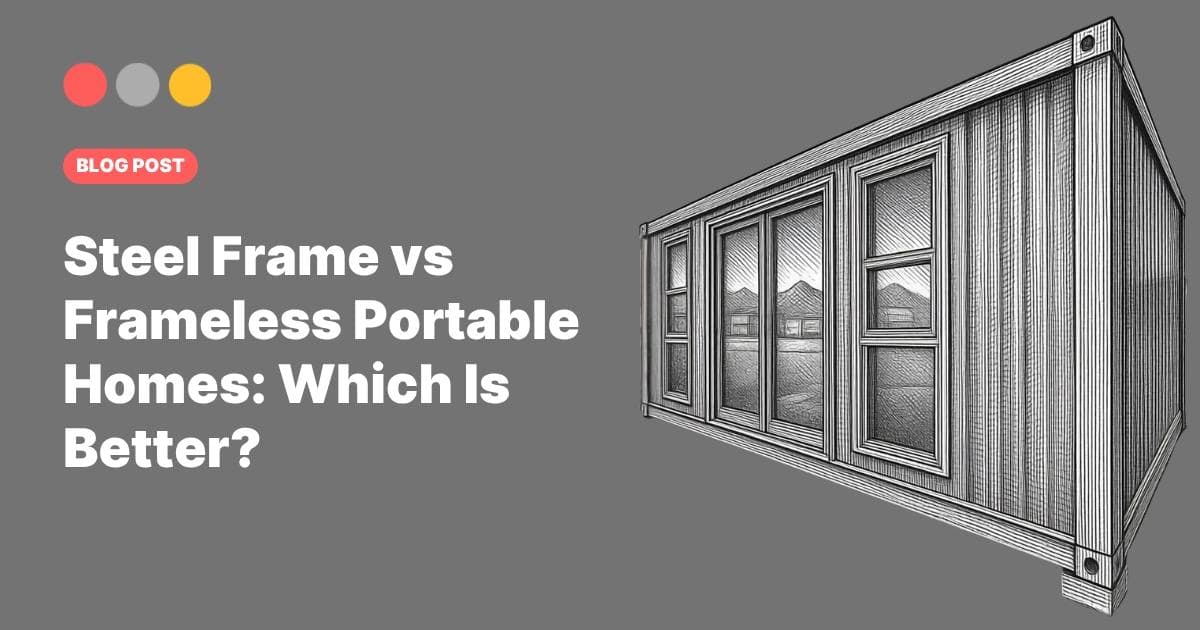
What is the difference between a steel-framed and frameless portable home?
A steel-framed portable home uses a rigid structural framework that supports the entire building. Wall panels are securely fixed to the frame, allowing structural loads to be distributed throughout the building instead of concentrating stress at individual panel joints.
A frameless portable home relies primarily on the insulated panels themselves for structural performance. The panels are connected directly together using fasteners and sealants, without a continuous steel framework running through the building.
Both systems can provide functional accommodation, but they behave very differently when subjected to wind loads, seismic movement, temperature changes, and years of everyday use.
Why structural framing matters
Every building experiences movement.
Wind pushes against walls.
Ground movement creates twisting forces.
Temperature changes cause materials to expand and contract.
Transporting a portable building also introduces stresses that traditional site-built homes never experience.
A continuous steel frame helps distribute these forces throughout the entire structure instead of concentrating them at individual joints.
This reduces stress on fasteners, helps maintain the building’s geometry, and improves the long-term durability of the home.
Wind resistance
New Zealand regularly experiences strong winds and severe storms, particularly in coastal regions.
Wind pressure increases rapidly as wind speed rises. Large wall surfaces transfer considerable forces into the structure, while changing gusts repeatedly apply positive and negative pressure to the building envelope.
In frameless homes, these forces are carried primarily by the connections between individual panels. Over many loading cycles, those connections experience repeated stress, which can gradually reduce the effectiveness of seals and fasteners.
A steel frame provides a much more rigid structural system.
Rather than allowing stress to concentrate at individual joints, the frame distributes wind loads throughout the building. This reduces fatigue at panel connections and helps maintain structural alignment over many years.
Maintaining that alignment is also important for keeping weather seals compressed evenly, reducing the likelihood of water entering through panel joints.
Earthquake performance
Much of New Zealand sits within an active seismic region.
Even relatively small earthquakes generate inertial forces throughout a building. Although portable homes are generally lighter than conventional houses, seismic movement still places significant demands on structural connections.
Portable homes are commonly installed on screw piles or concrete foundations rather than deep slabs, meaning ground movement can introduce twisting and shear forces into the structure.
A steel frame improves performance by providing continuous rigidity throughout the building.
Steel also possesses an important engineering property known as ductility. Rather than fracturing suddenly, steel can undergo controlled deformation while absorbing energy during peak loading events.
This ability to redistribute loads helps protect panel connections and reduces the likelihood of permanent structural damage during seismic events.
Moisture resistance
Long-term moisture protection depends on much more than sealants alone.
In frameless construction, panel joints rely almost entirely on local fasteners and sealants to remain watertight. Small amounts of structural movement caused by wind, transport, or seasonal temperature changes can gradually reduce sealing performance.
Once moisture enters concealed joints, it can create conditions favourable for mould growth and hidden water damage.
A steel frame helps minimise movement between adjoining panels by keeping each panel securely supported along its length.
Maintaining consistent pressure across sealing systems helps create a more durable weather-resistant building envelope while reducing the likelihood of moisture ingress over time.
Steel frame vs frameless portable homes
Frameless portable homes may offer:
- Lower upfront purchase price
- Lighter weight for transportation
- Simpler modifications in some situations
However, they may also involve:
- Greater reliance on panel joints for structural strength
- Higher long-term maintenance requirements
- Increased risk of movement affecting seals
- Reduced resistance to repeated wind loading
- Less structural redundancy during seismic events
Steel-framed portable homes offer:
- Excellent structural rigidity
- Better distribution of wind and seismic loads
- Improved long-term dimensional stability
- Reduced movement between wall panels
- Better long-term weather resistance
- Greater durability over decades of use
Although steel-framed homes typically require a larger initial investment, many buyers consider the added structural integrity worthwhile for long-term ownership.
Is a steel frame worth the extra investment?
Choosing between a steel-framed and frameless portable home ultimately depends on your priorities.
If the primary goal is the lowest possible upfront cost, a frameless design may appear attractive.
However, if you value long-term structural performance, durability, resistance to severe weather, and reduced maintenance over the life of the building, investing in a steel-framed home can provide significant long-term benefits.
Rather than focusing only on the purchase price, it is worth considering how the home is likely to perform after years of transport, weather exposure, and everyday use.
Final thoughts
The structural system is one of the most important differences between portable homes, even though it is largely hidden once construction is complete.
At Portable Building Specialists, heavy-duty steel framing is included as a standard feature because we believe a portable home should be designed to perform reliably for decades, not simply to minimise upfront manufacturing costs.
By combining quality insulated panels with a robust steel framework, our homes are designed to provide greater structural integrity, improved resistance to wind and seismic activity, and long-lasting protection against the elements.
If you are comparing different portable homes, take time to look beyond the finishes and ask what is supporting the building beneath the walls. The answer can make a significant difference to the home’s long-term performance, durability, and value.